Siam Rahman graduated from North South University with a foundation in architectural education and research-driven thinking. He is the founder of Diegetic Space Synchronicity (DSS), a research-based firm exploring experimental approaches to architecture through technology and innovation. His research and design focus includes Artificial Intelligence (AI), Machine Learning, computational design methods and data-driven, algorithmic design exploration. He is actively engaged in professional design practice, collaborating with two architecture firms, bridging research and real-world architectural implementation.
PROJECT
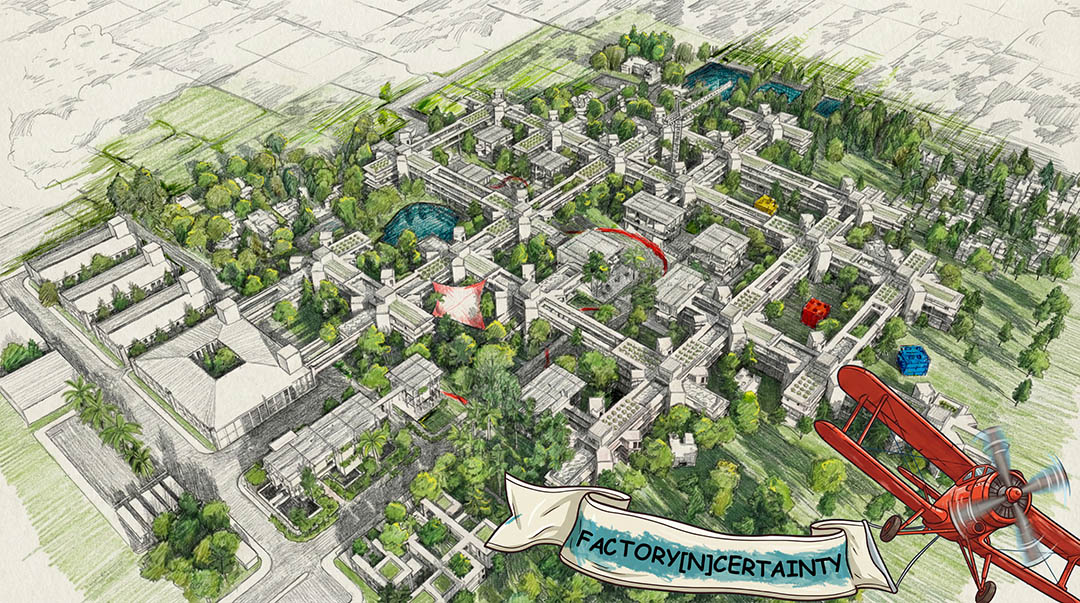
Factory [N] Certainty
© Siam Rahman | NSU
Story Board © Siam Rahman | NSU
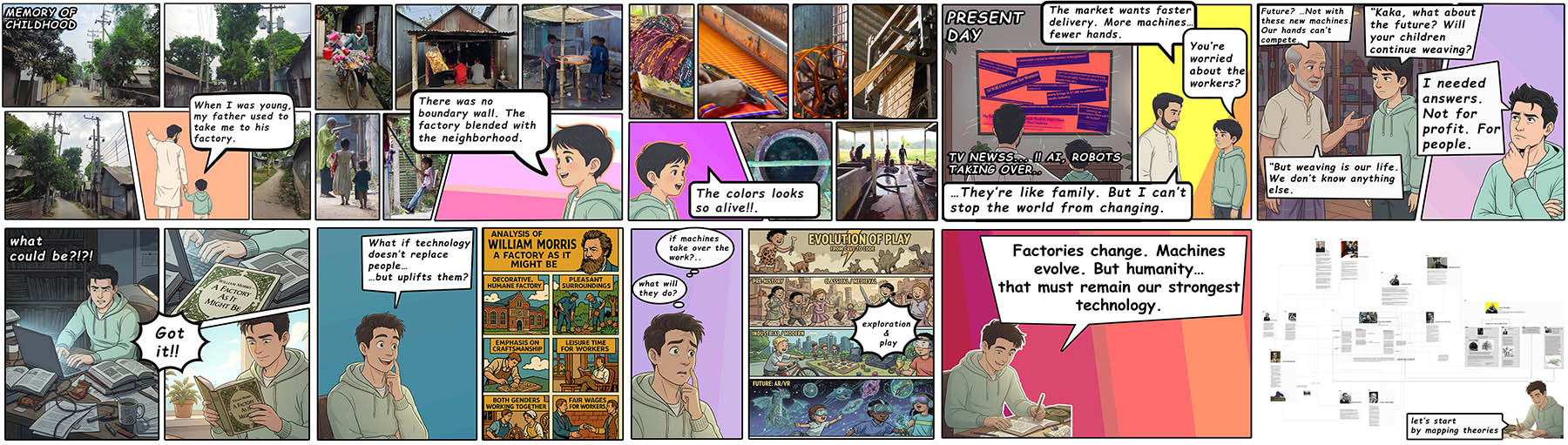
I still remember the factory from my childhood. There was no boundary wall. It wasn't separate from us - it was part of our neighbourhood, part of our life. My father used to take me there, and I would watch the colors of the threads move through the looms like flowing rivers. The sounds, the rhythm the people it all felt alive. The factory wasn't just a workplace. It was family.
Years passed. The world changed...
One day I saw the headlines: Al. Robots. Automation taking over. The market demanding faster delivery, fewer hands.
People whispered that our hands could no longer compete. I saw the worry in the workers' faces. If machines take over, what will happen to them? If weaving is our life, what happens when the loom no longer needs us?
I couldn't accept that the story would end there...
So, I searched for answers - not for profit, but for people. I began to imagine something different. What if technology didn't replace workers... but uplifted them? What if machines carried the burden of repetition, while humans focused on creativity, care, and connection?
Factories have always changed. Tools evolve. Play evolves. Work evolves. But humanity - our curiosity, our collaboration, our imagination that must remain.
"The future of the factory is not a battle between humans and machines. It is a dialogue. And in that dialogue, humanity must remain our strongest technology."
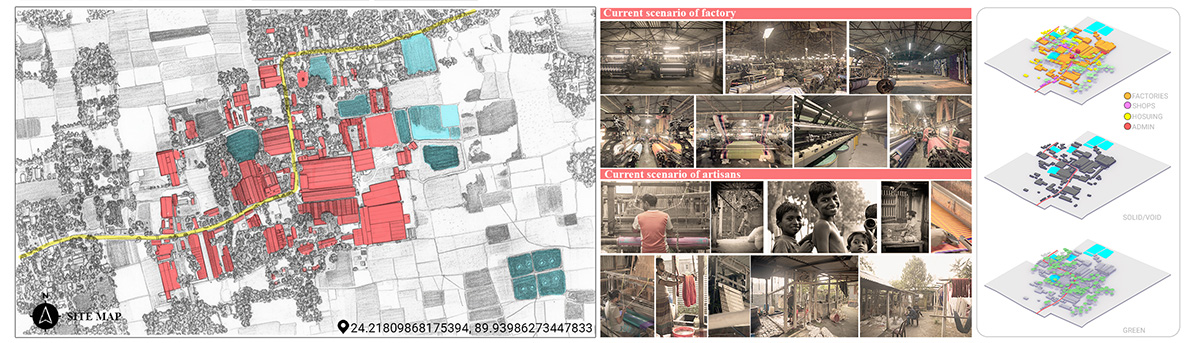
Site and Context © Siam Rahman | NSU
The site is a semi-rural textile production cluster located along a primary road spine (highlighted in yellow), with dense factory sheds (red) embedded directly within the village fabric. There is no strict zoning-industrial buildings, artisan homes, ponds (blue), and agricultural fields coexist organically. The factory complex has grown incrementally, creating a tight network of narrow internal paths and mixed-use edges.
Current conditions show aging industrial sheds with low environmental performance and informal artisan workspaces integrated into residential areas. The spatial pattern reflects an unplanned yet socially connected ecosystem where production, living, and community life overlap without clear boundaries.
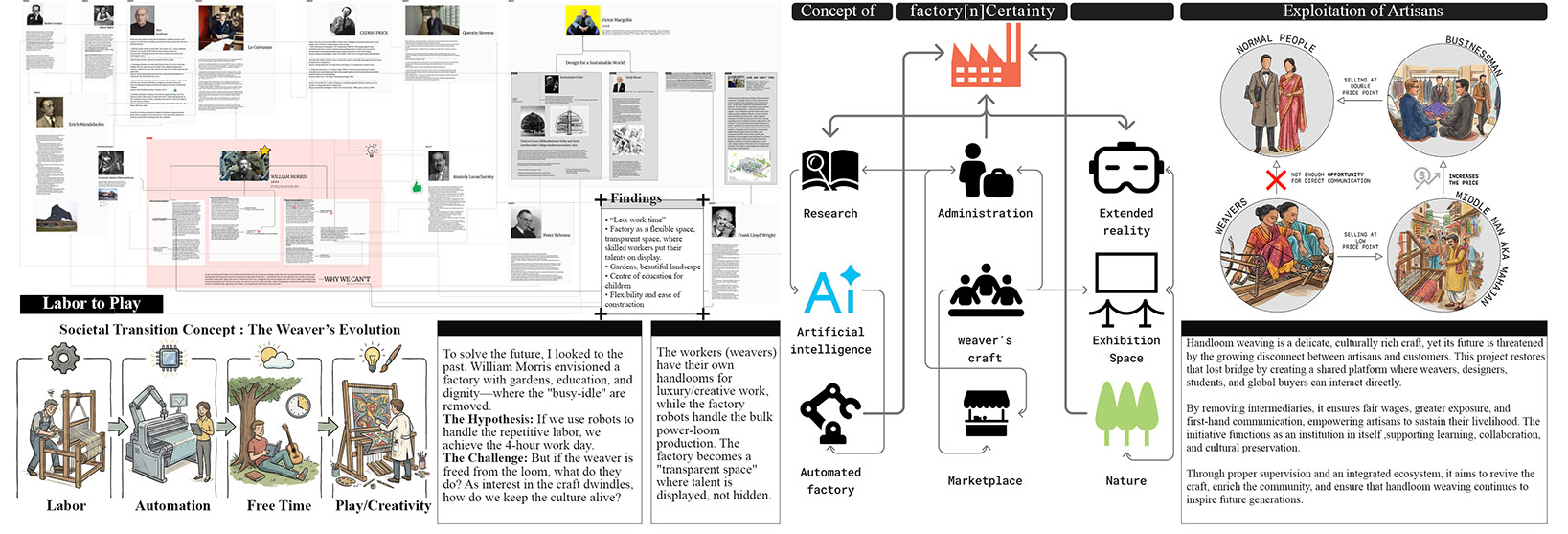
Findings and Questions © Siam Rahman | NSU
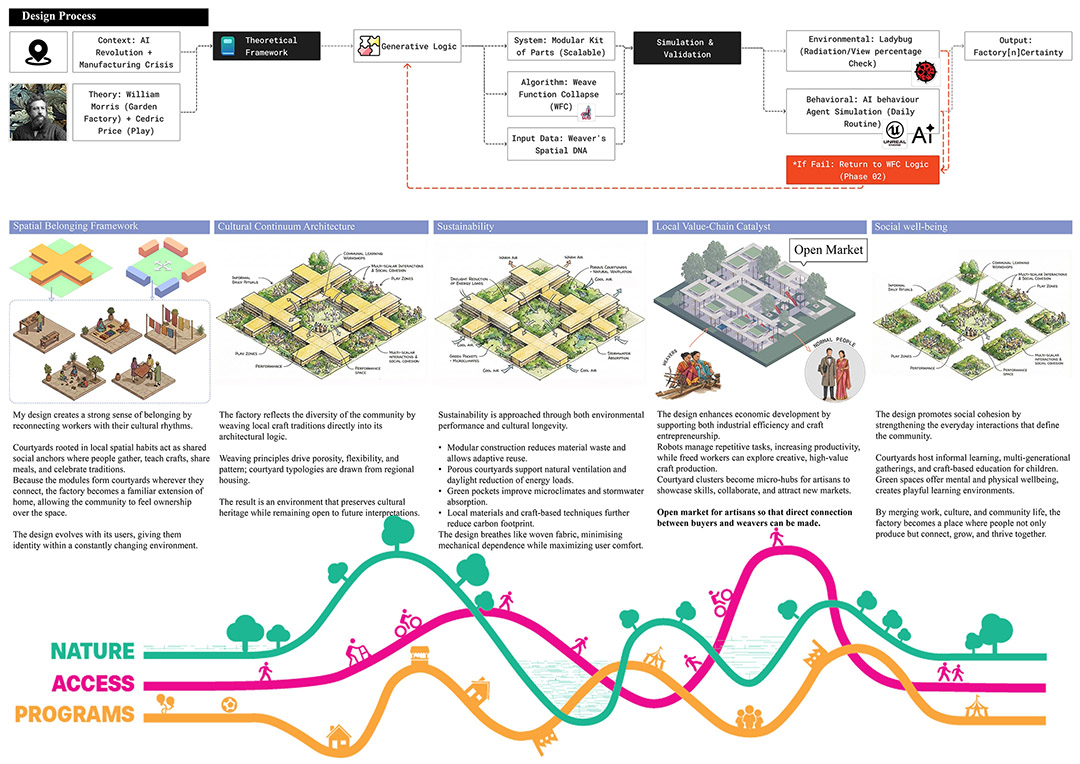
Design Process Theoretical Background © Siam Rahman | NSU
The foundation of the design is deeply rooted in craft culture and the existing social fabric of weaving communities. The ethos of traditional textile production, including collaboration, shared courtyards, intergenerational skill transfer, and collective identity, shapes the spatial DNA of the factory. The project draws inspiration from craft theorists such as William Morris, who believed that meaningful work and humane environments are inseparable. Morris advocated for an architecture in which making, living, and socializing are intertwined. This principle is revived here, not as nostalgia, but as a forward-looking stance. The design respects the continuity of craft while embracing technological evolution, acknowledging that artisans, power-loom operators, and automated systems are not separate worlds but connected strands of the same cultural narrative. It also draws from Cedric Price’s idea of adaptable, time-based architecture and Constant Nieuwenhuys’s vision of a flexible, ever-evolving spatial world shaped by human activity and creativity.
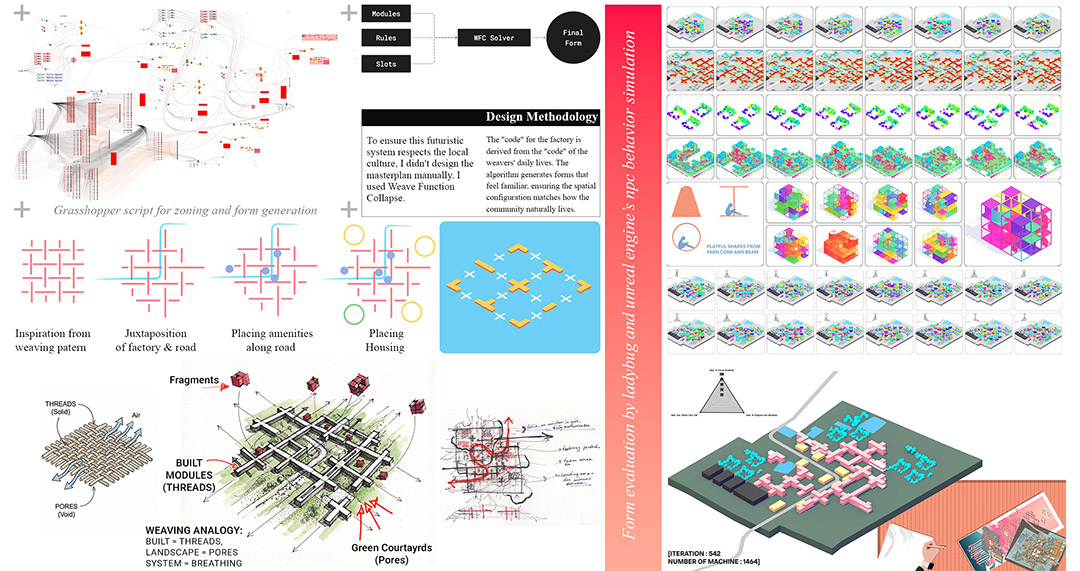
Grasshopper Simulation and Design Formation © Siam Rahman | NSU
The design process began unconventionally. It did not start with a fixed form, but with theory, behaviour, and environmental logic. The first step was to ground the concept in theoretical frameworks and then translate them into modular units. Each module is capable of recombining like living cells. These modules were iterated more than a thousand times, forming endless spatial possibilities. In every combination, courtyards naturally emerged as breathing voids, places of rest, exchange, and micro-climate stability. These courtyards became an essential component of the factory’s identity, inspired by the way traditional weaving communities used open spaces for dyeing, drying, weaving support activities, and social gathering.
Environmental performance became a primary design driver. Using Ladybug radiation analysis, all modular arrangements were tested to ensure thermal comfort and reduced heat gain, which are critical factors for large industrial floors. From over a thousand simulations, twenty-five low-radiation iterations were shortlisted. Environmental logic alone, however, was not sufficient. The project aimed to understand how humans would interact with and inhabit these spaces in real time.
To integrate human behaviour into the design, the project employed AI-driven virtual agents inside Unreal Engine. These AI agents were crafted with diverse daily schedules representing handloom weavers, power-loom workers, and fully automated system supervisors. Each Agents performed activities such as working, resting, chatting, commuting, sleeping, and eating. This allowed the design to be tested socially, not just environmentally. Their movement patterns revealed how courtyards acted as social condensers, how proximity between work and housing influenced rest cycles, and how circulation was shaped by rhythms of production.
The evaluation used three key parameters. The first measured the maximum percentage of social interactions to understand how often and where people meet. The second assessed the maximum percentage of program use to identify which spaces were most active or underutilized. The third measured the average mesh face occupancy to determine how efficiently people occupy the architectural surfaces and paths.
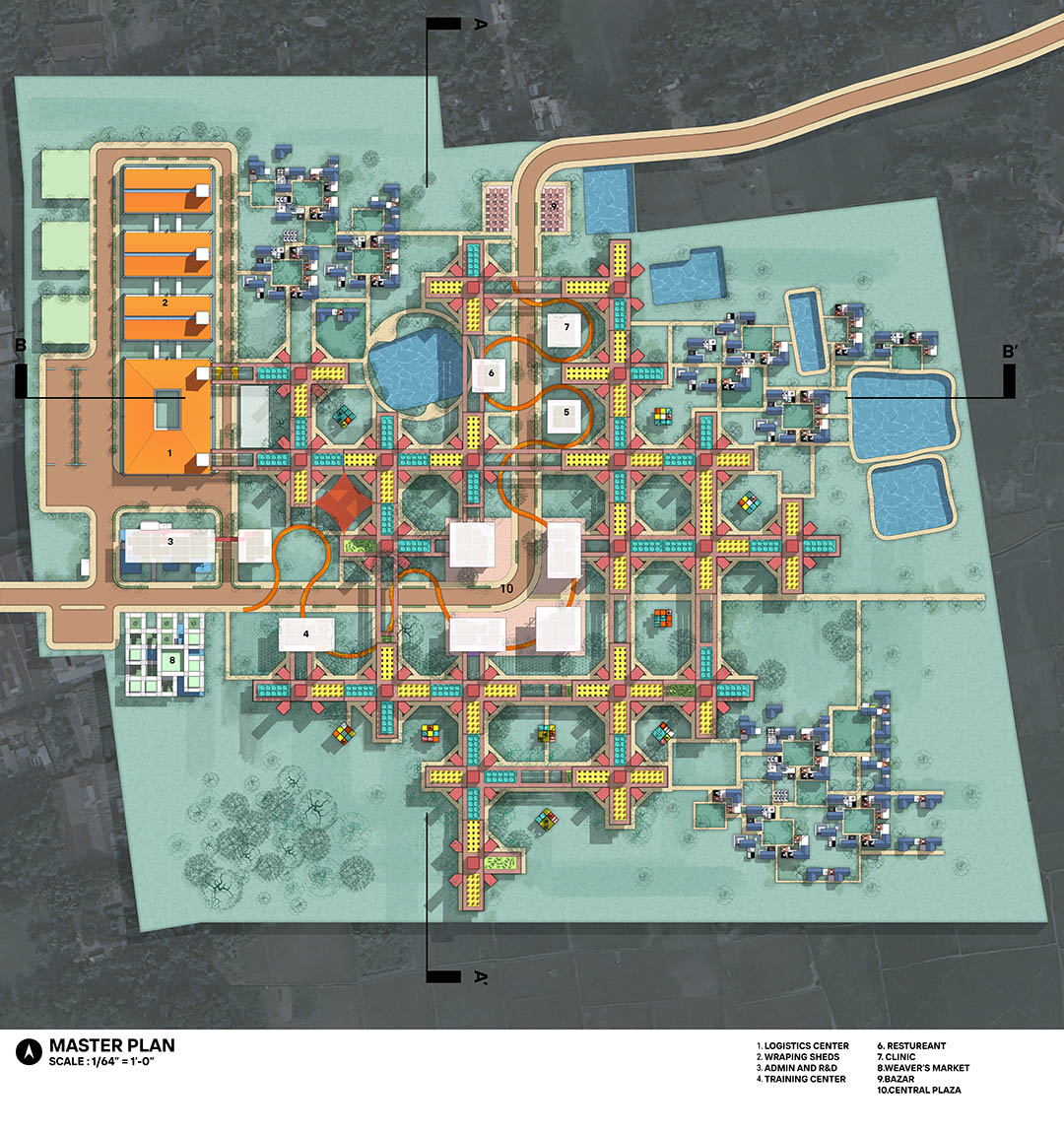
Master Plan © Siam Rahman | NSU
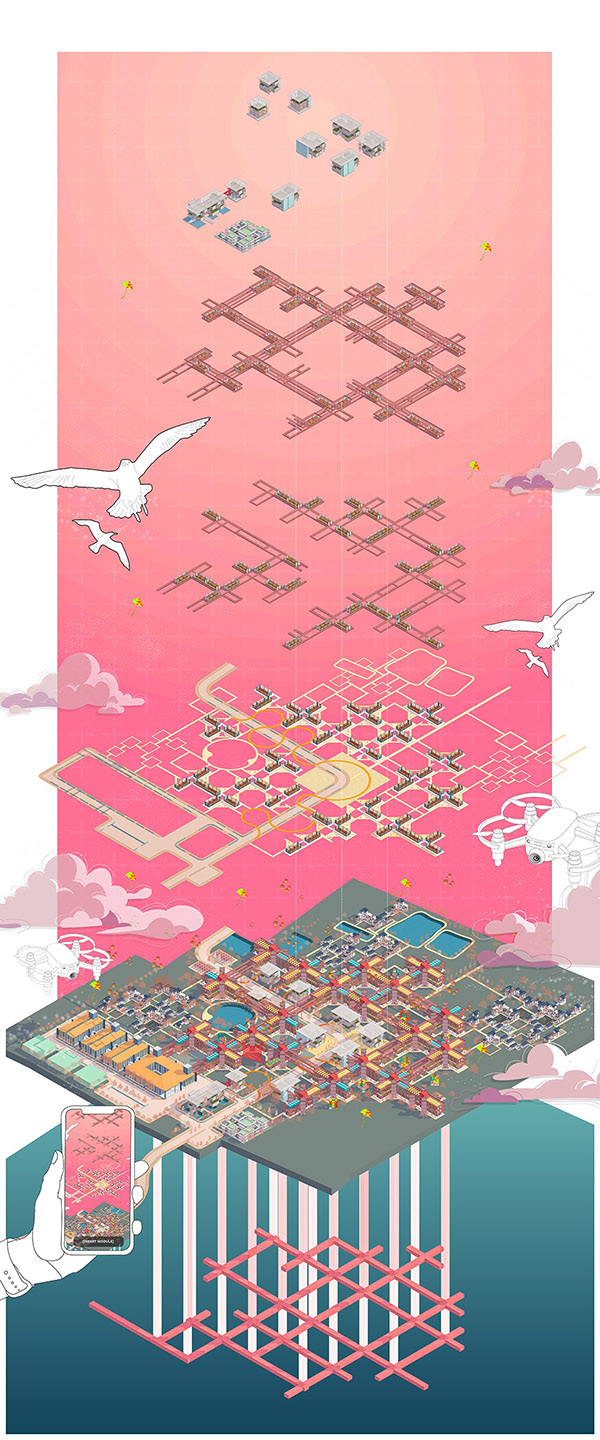
Axonometric Diagram © Siam Rahman | NSU
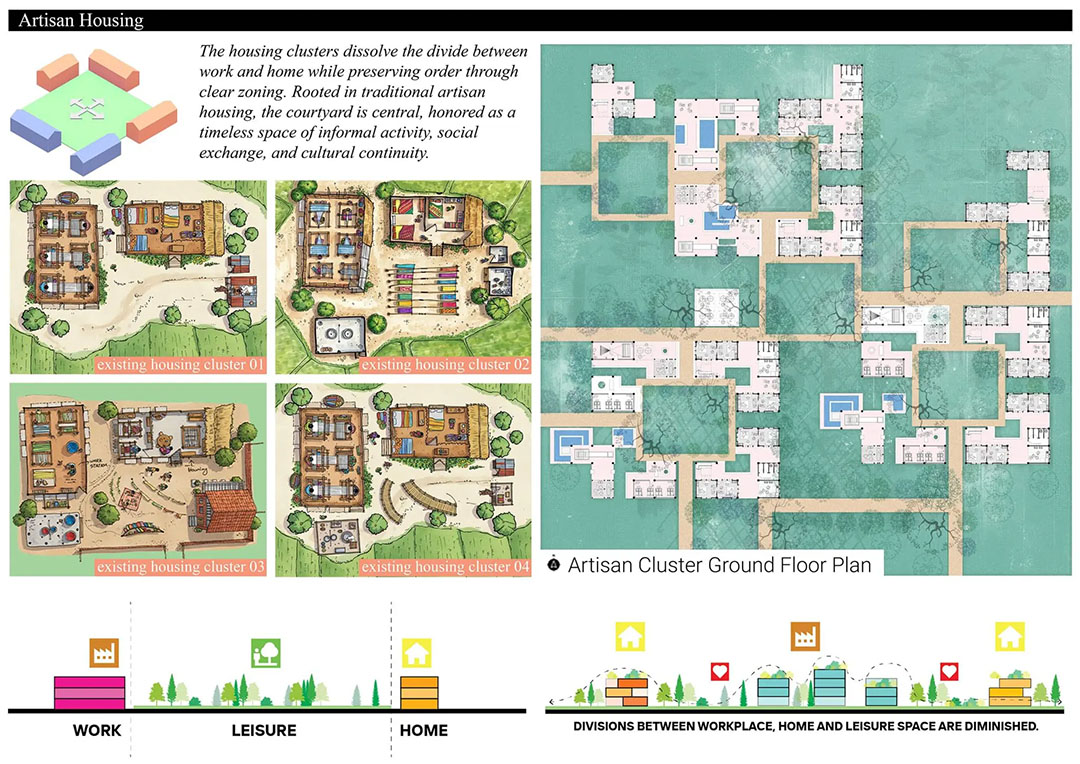
Artisan Housing © Siam Rahman | NSU
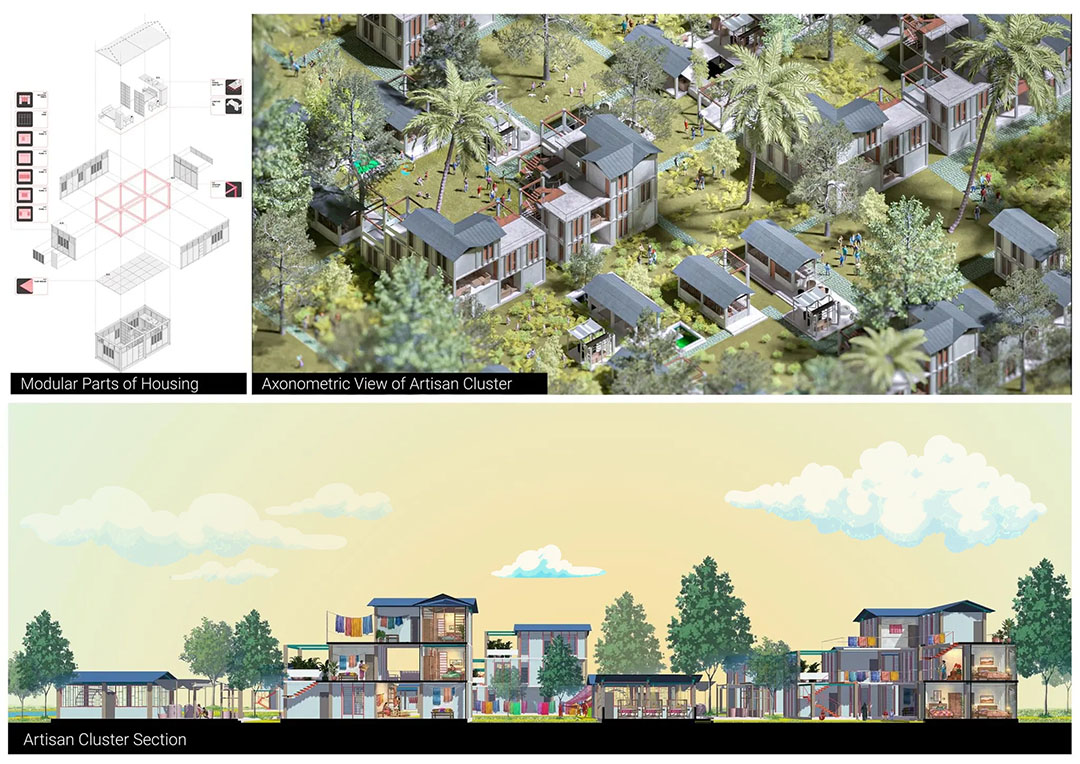
Artisan Housing © Siam Rahman | NSU
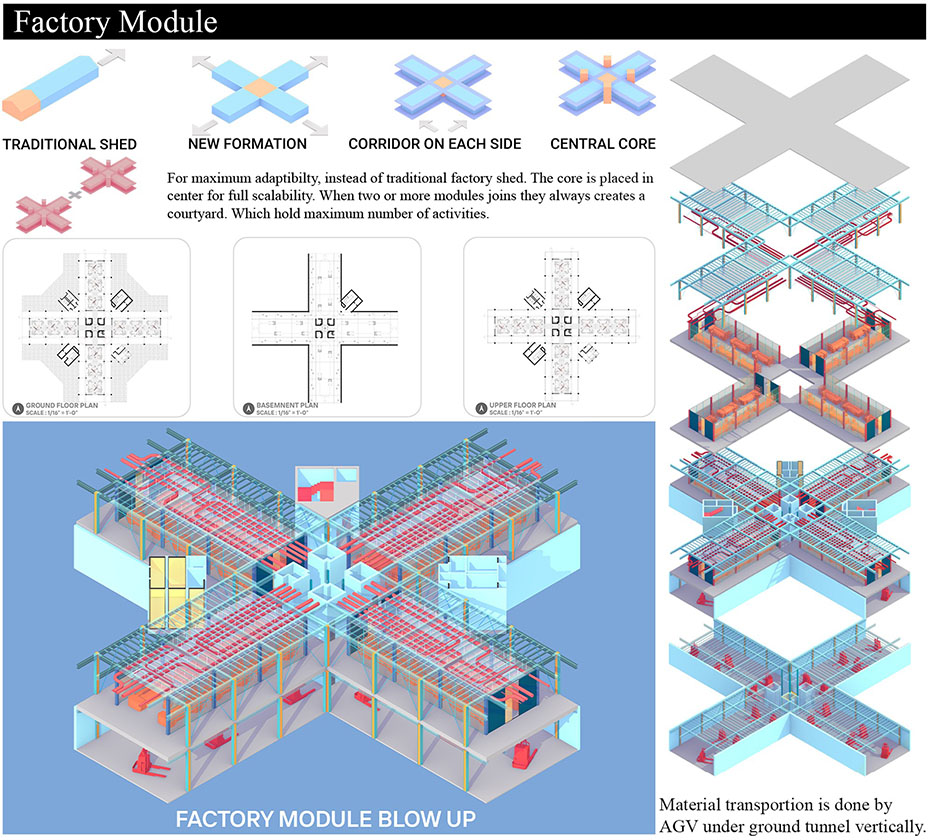
Automated Factory Detail © Siam Rahman | NSU
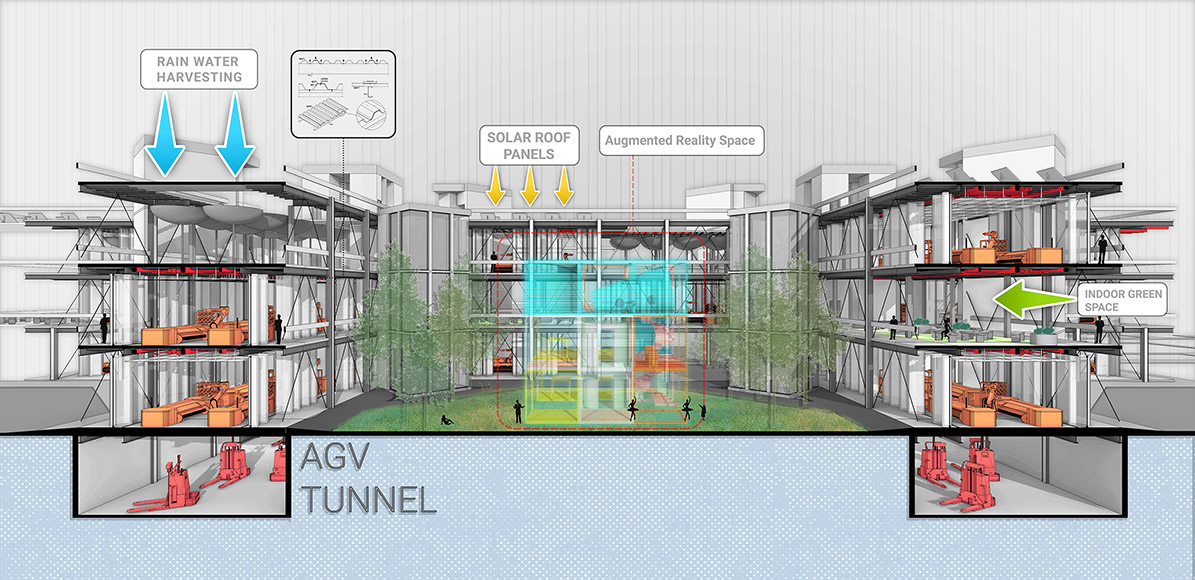
AGV Tunnel Section of Automated Factory © Siam Rahman | NSU
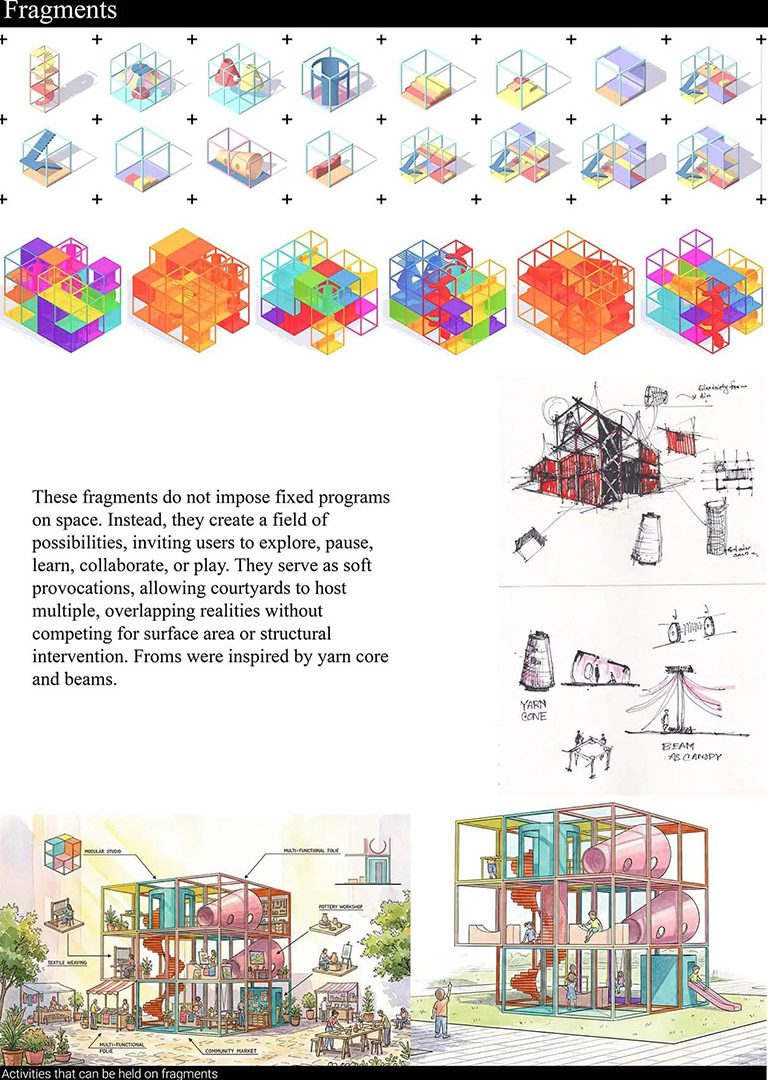
Fragments Detail © Siam Rahman | NSU
Through this rigorous process, the final iteration, identified as Iteration 542, emerged as the optimal configuration. It aligned around climate-responsive courtyards, and balanced between housing on the east and work modules on the west. This spatial system produces a gradient from intense production zones to quieter living clusters, mirroring the rhythm of human life.
To enhance the human experience further, the project integrates “fragments” architectural insertions placed within courtyards. These fragments act as experiential anchors, such as small pavilions, shaded resting decks, and cultural nodes. They echo the conceptual lineage of architectural follies but reinterpret them as functional and sensory devices. These fragments activate space, encourage community use, and enrich daily rituals. They become atmospheres rather than objects, giving workers spaces to pause, interact, and reconnect with their environment. These fragments can be experienced in virtual reality and augmented reality. AR and VR installations allow workers, designers, and visitors to interact with future scenarios of the factory, while an Unreal Engine based community game enables them to test, customize, and contribute to the evolving spatial system.
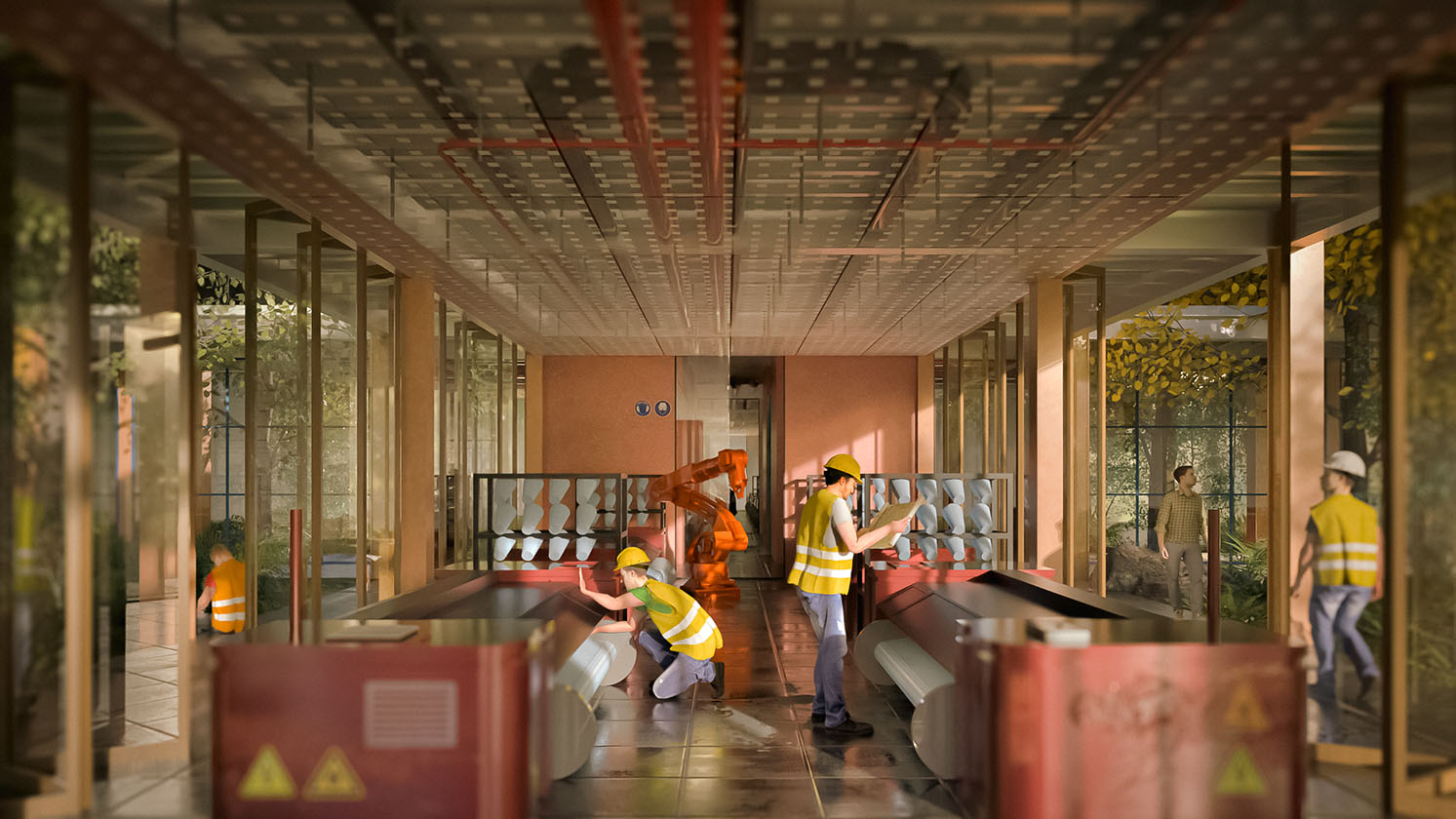
Inside of Automated Factory © Siam Rahman | NSU
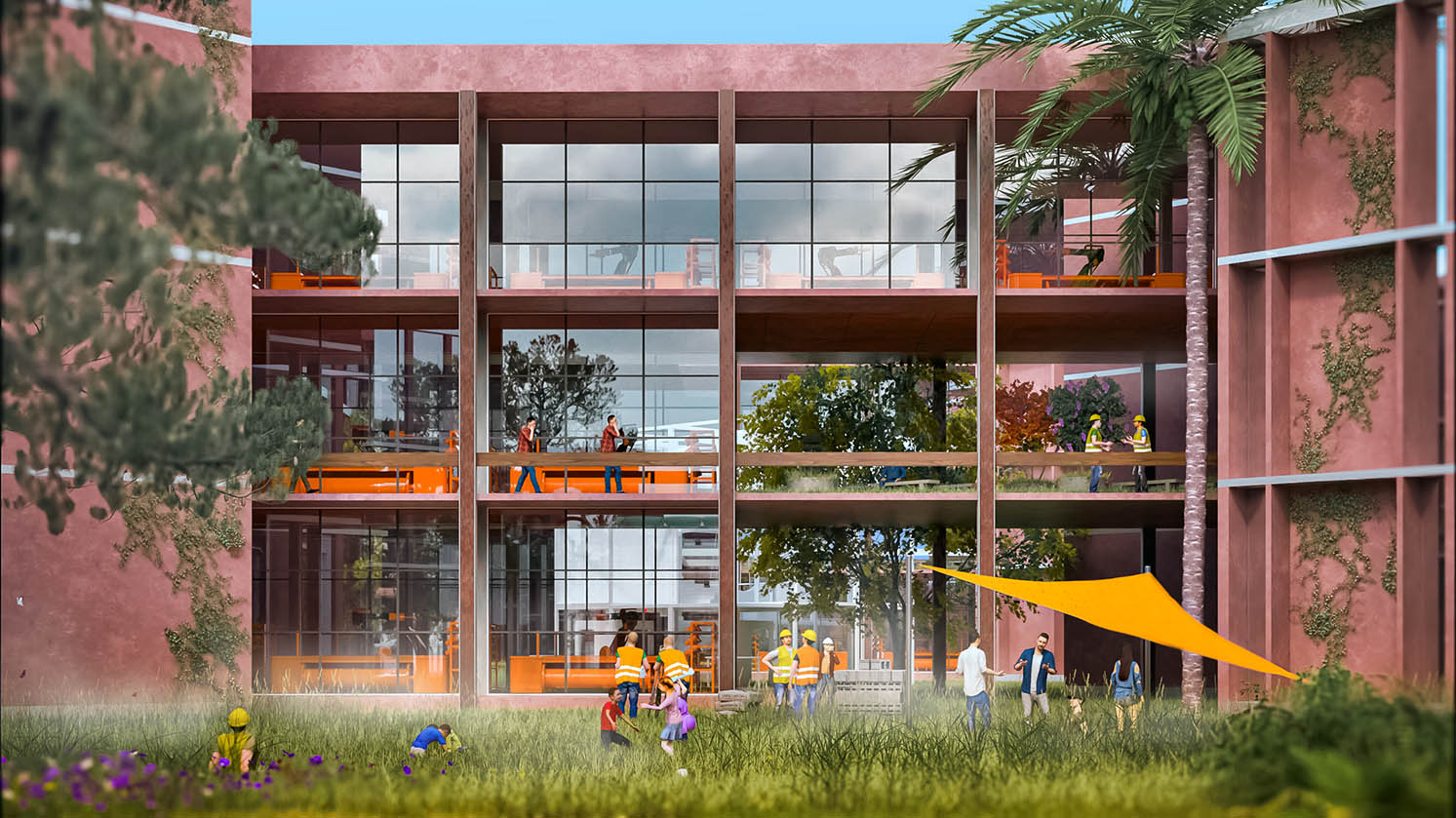
View of Factory © Siam Rahman | NSU
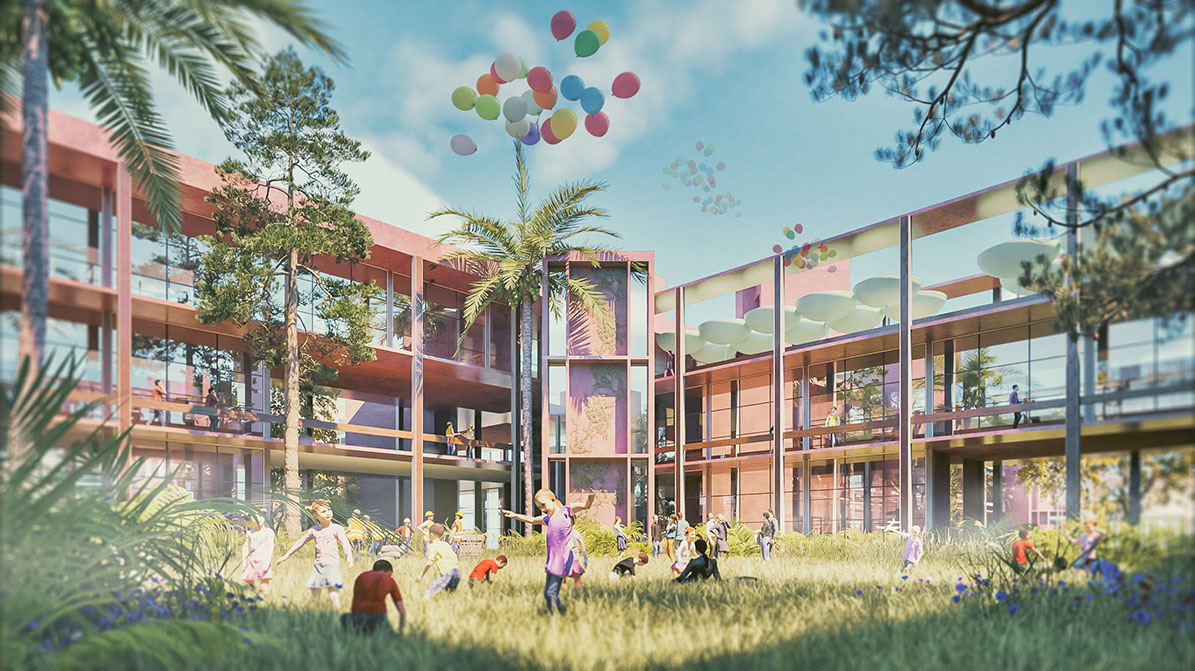
View of Factory Courtyard at Day © Siam Rahman | NSU
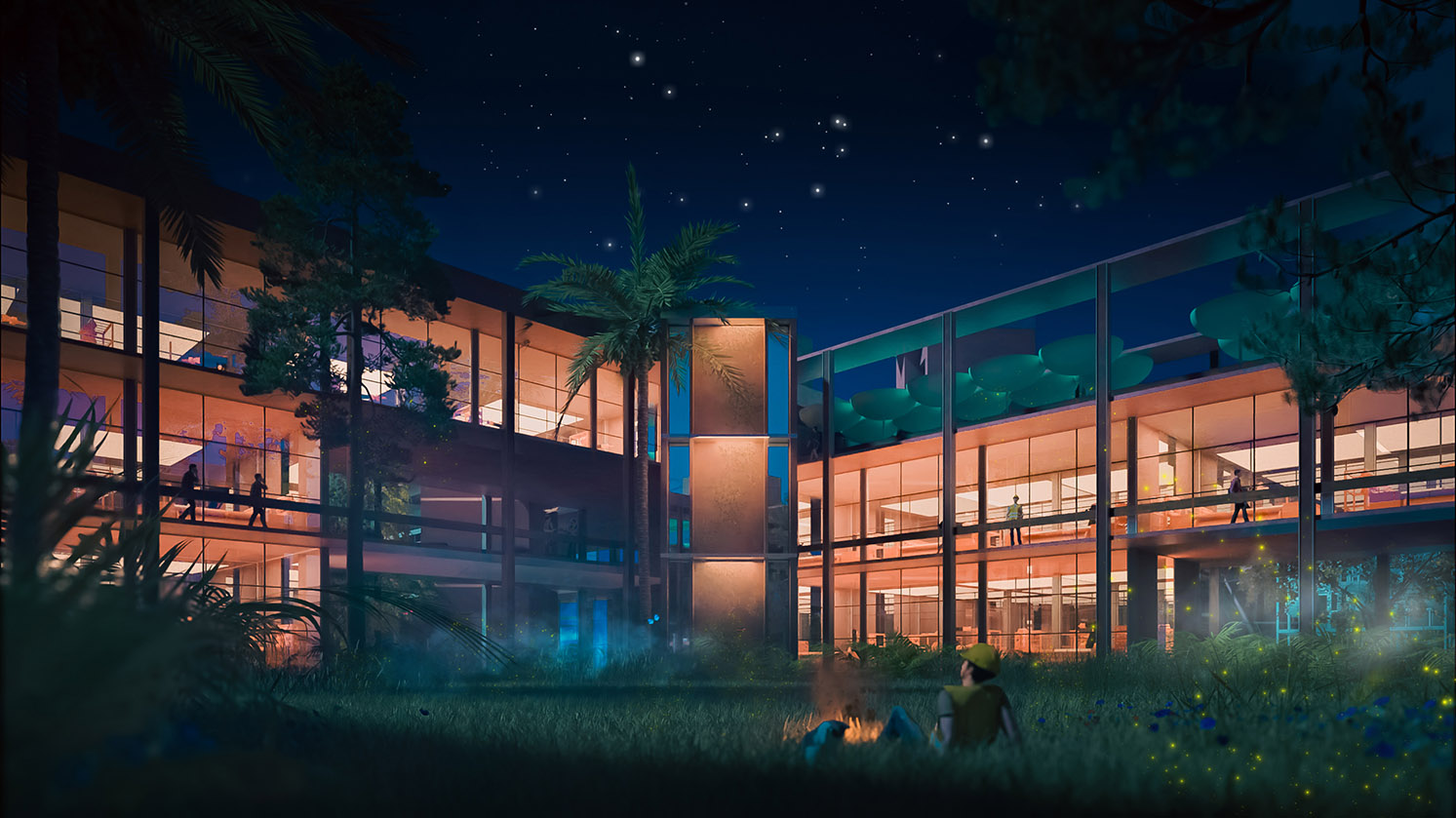
View of Factory Courtyard at Night © Siam Rahman | NSU
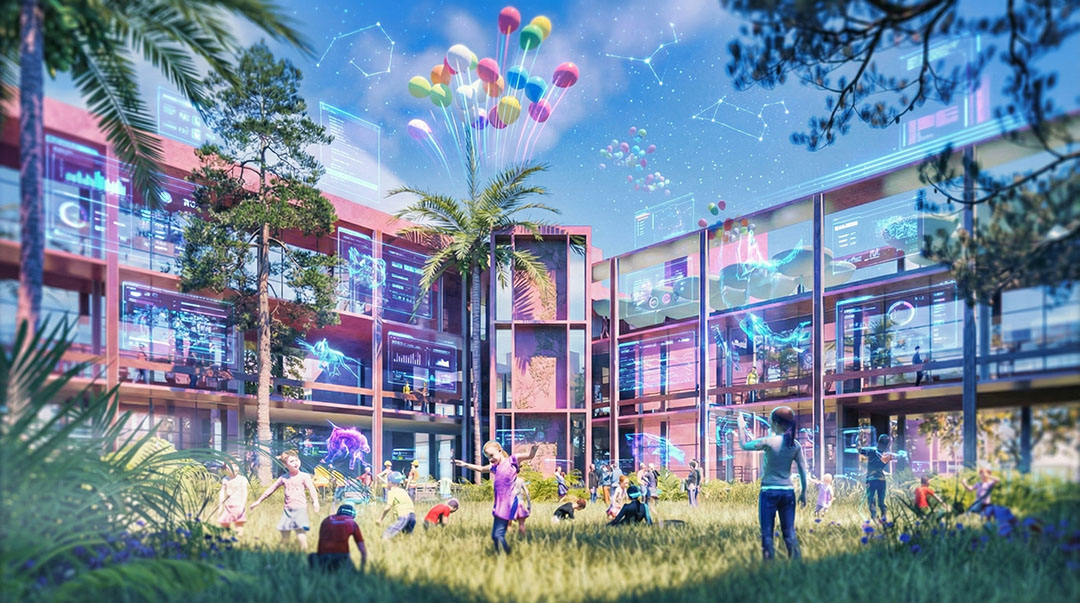
View of Factory Courtyard in Augmented Reality © Siam Rahman | NSU
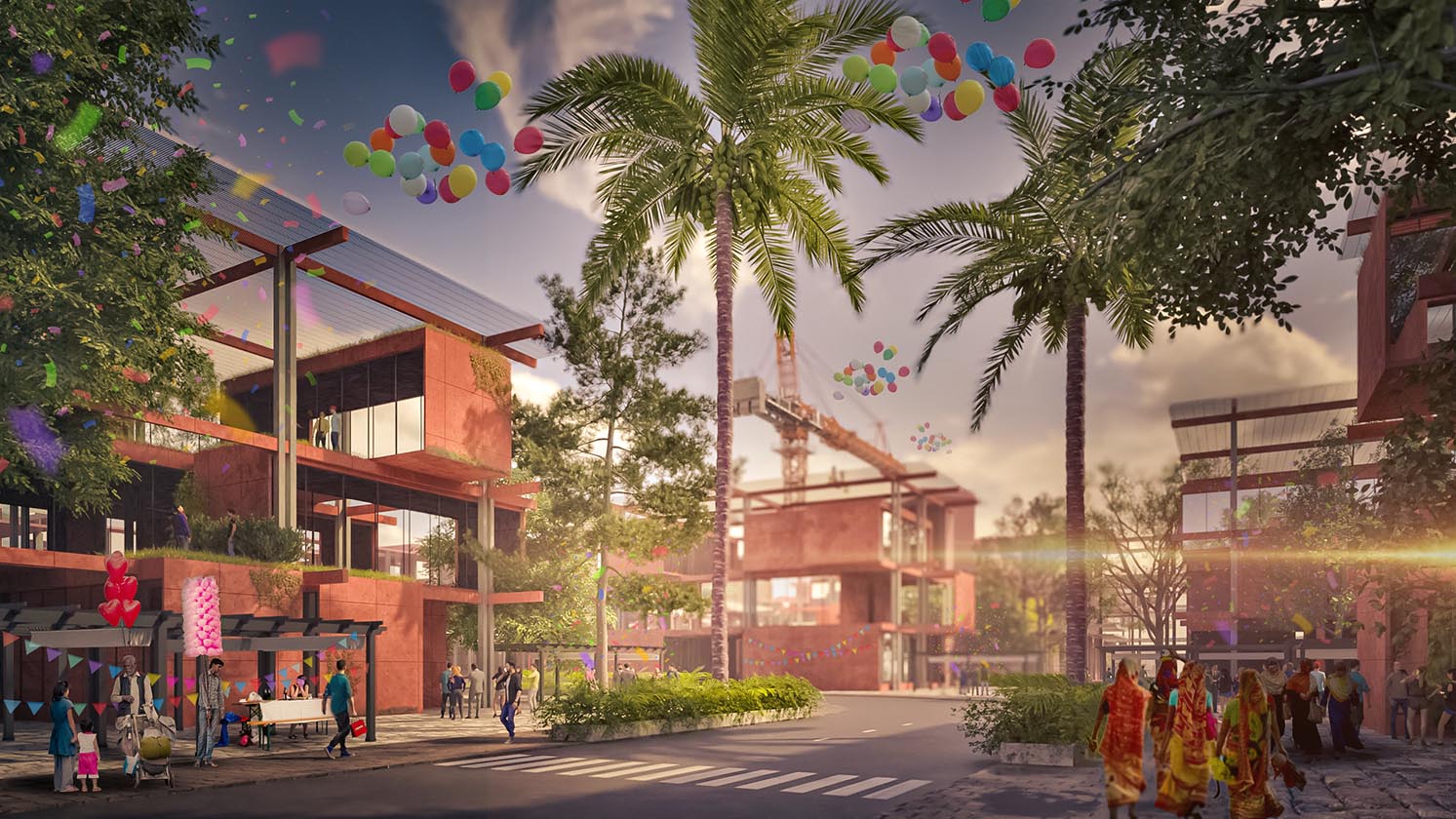
View of Central Plaza © Siam Rahman | NSU
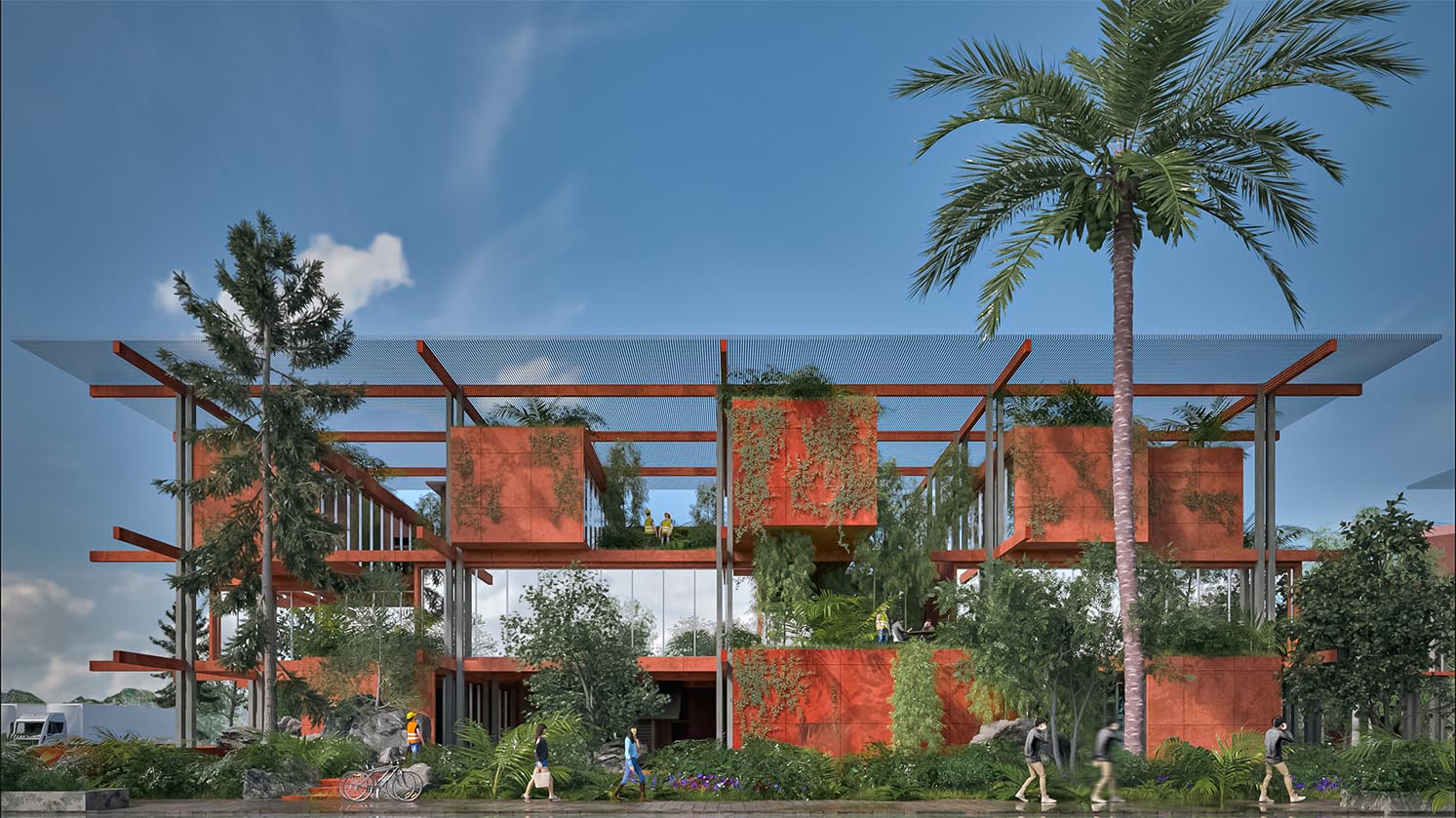
View of Amenities building © Siam Rahman | NSU
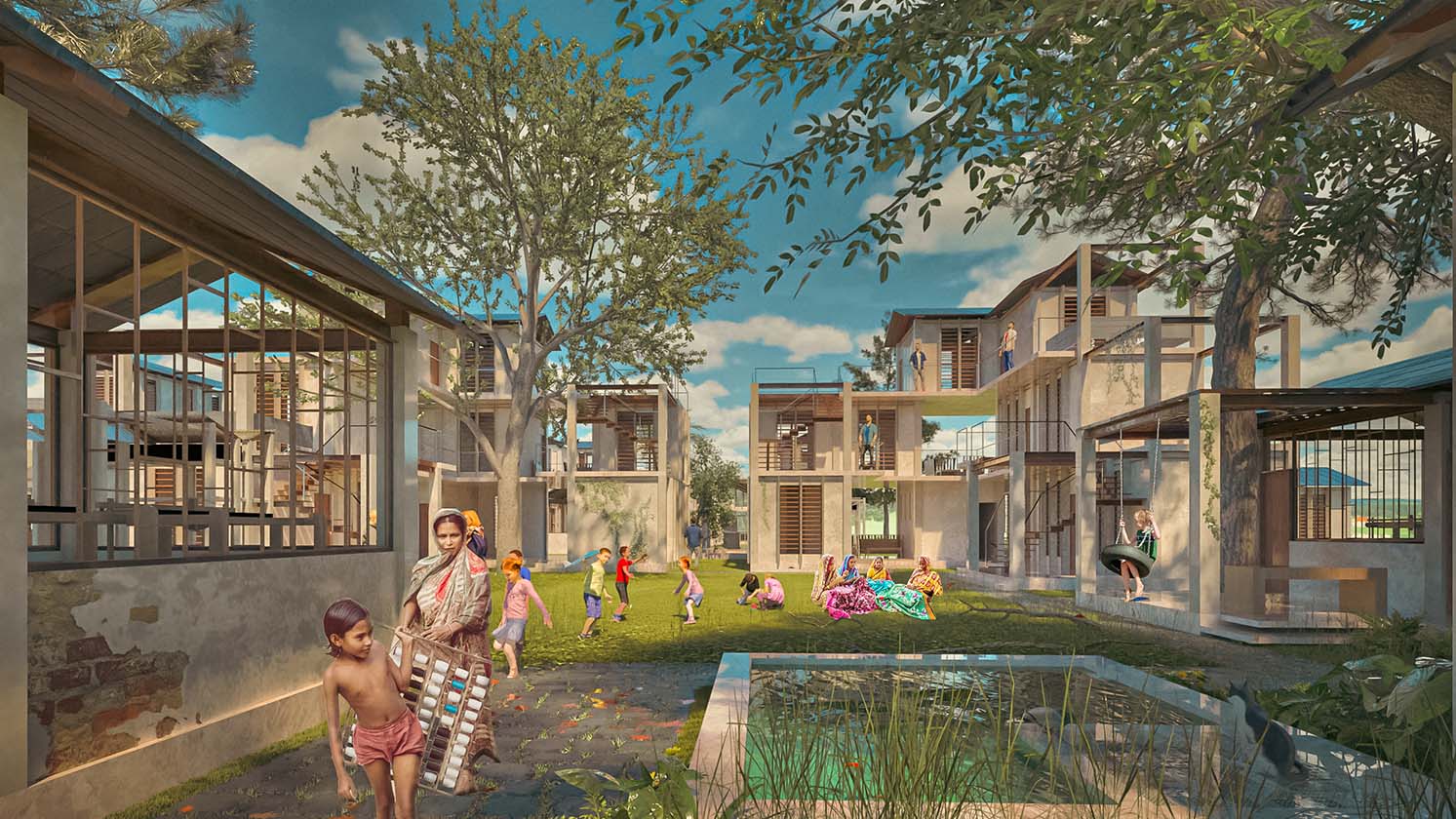
View of Artisans Housing Chester © Siam Rahman | NSU
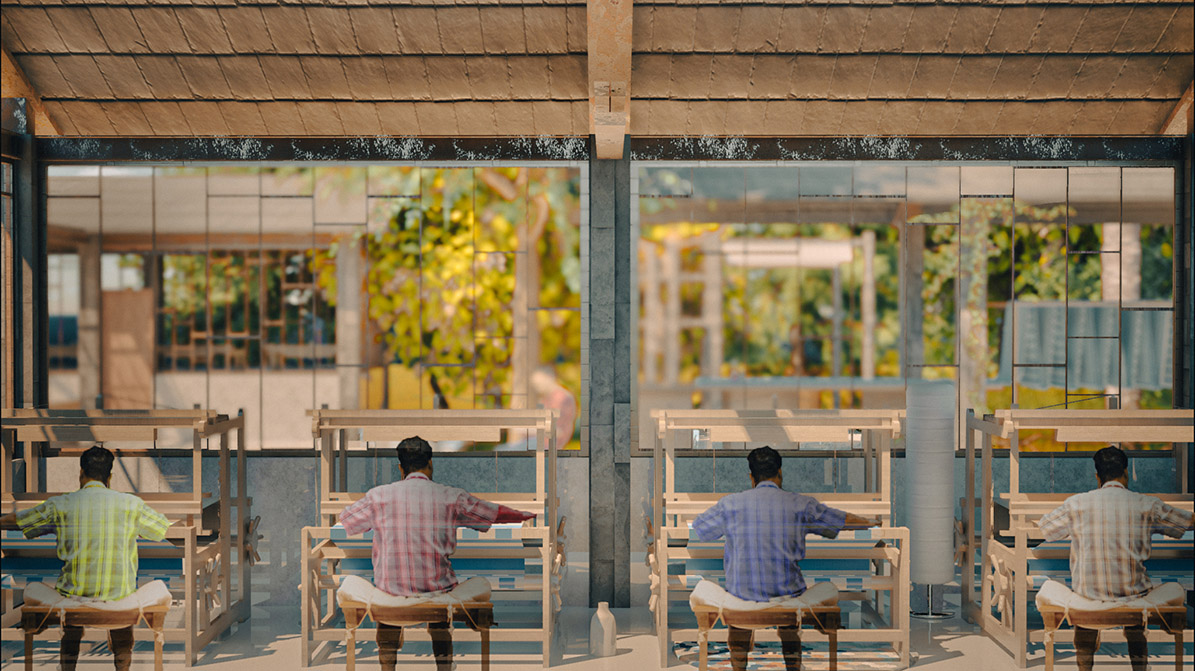
View of Artisan's Weaving Space © Siam Rahman | NSU
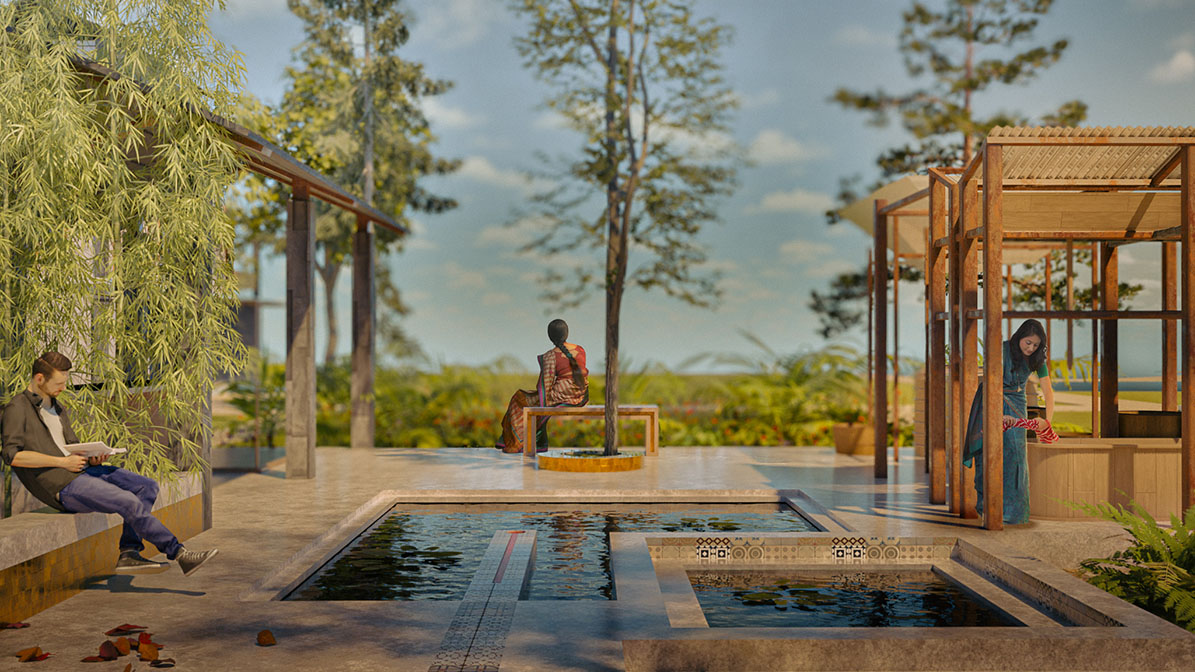
View of Artisan's Dyeing Zone © Siam Rahman | NSU
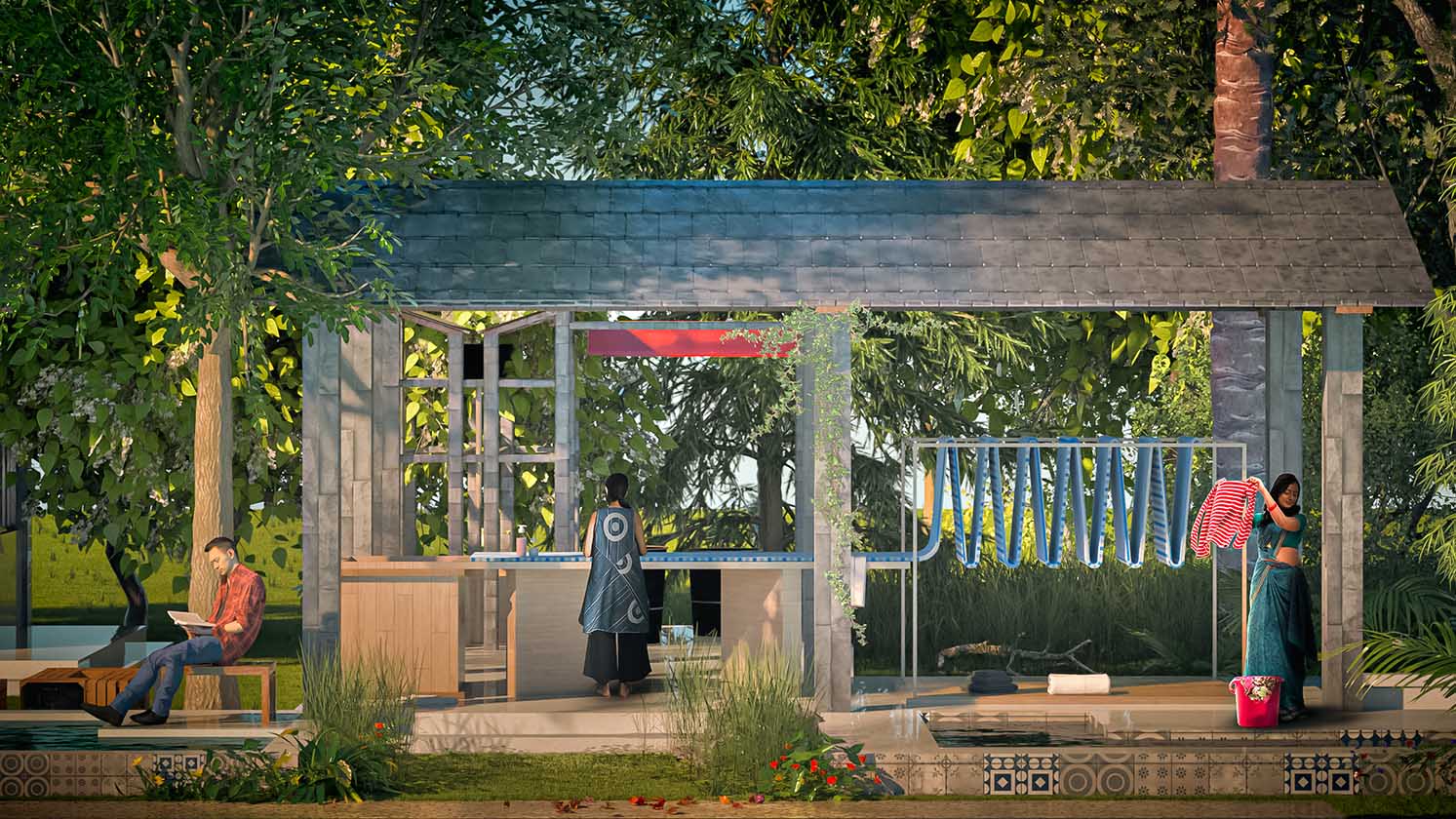
View of Batik Printing Zone © Siam Rahman | NSU
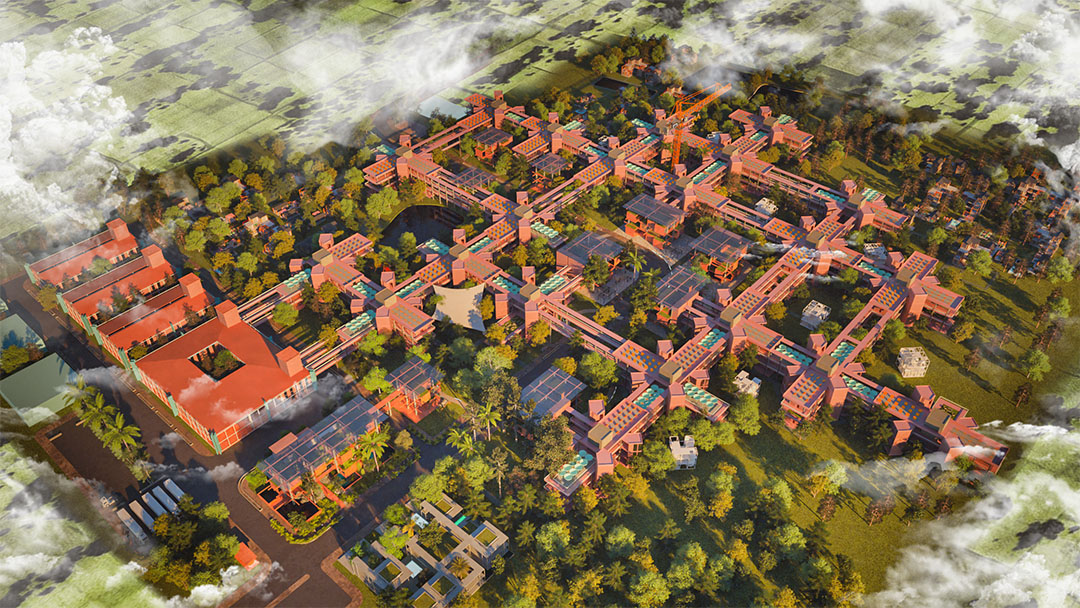
View of Whole Factory © Siam Rahman | NSU
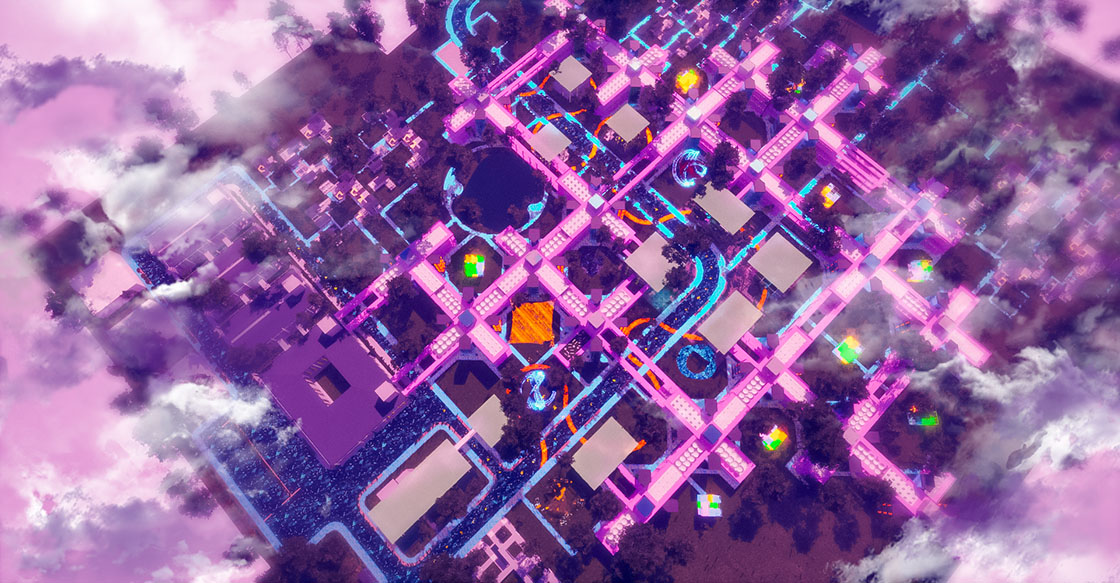
View of Whole Factory in Augmented Reality © Siam Rahman | NSU
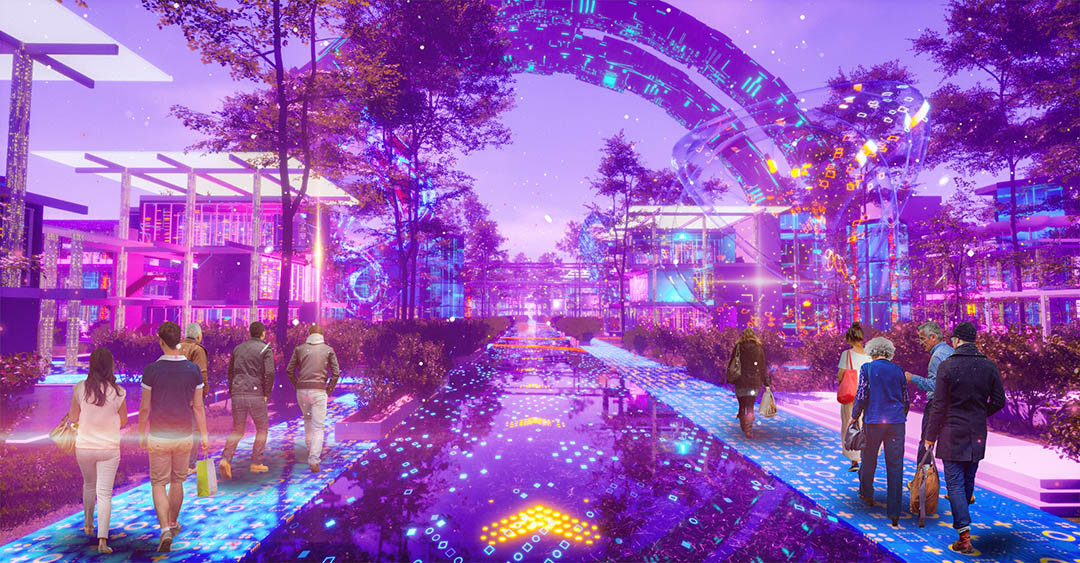
Factory in Augmented Reality © Siam Rahman | NSU
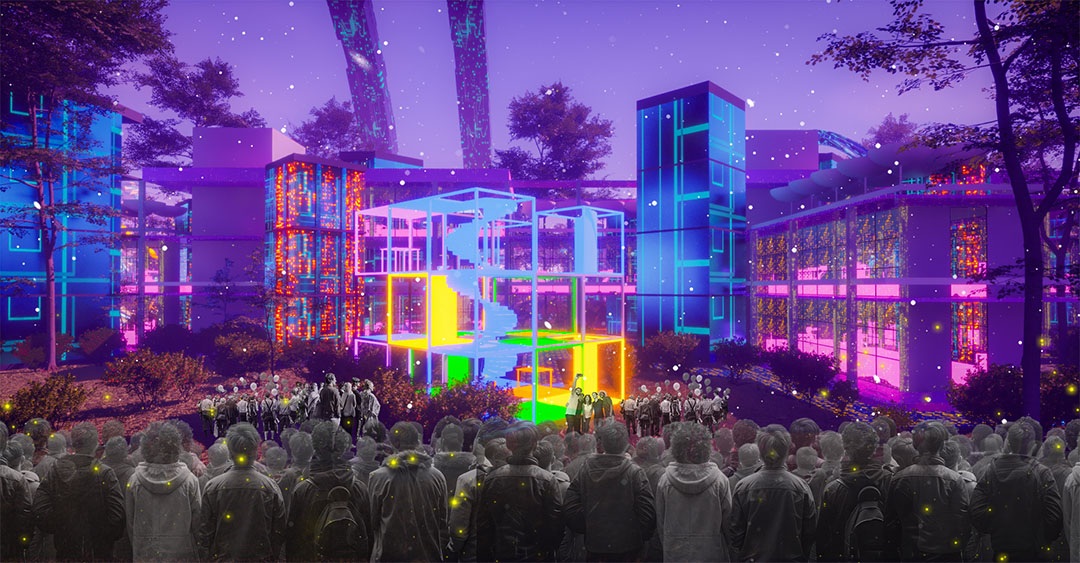
Fragments in Augmented Reality © Siam Rahman | NSU
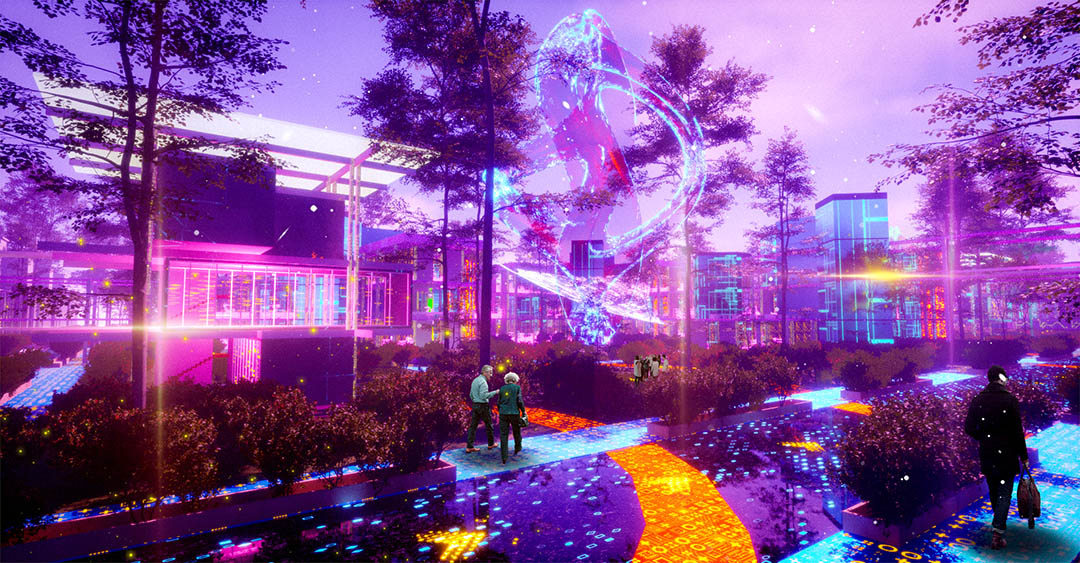
View Towards Central Plaza in Augmented Reality © Siam Rahman | NSU
Cultural continuity is essential to the project. The design respects the lived reality of weaving communities, where work is more than economic activity. It is heritage, memory, and identity. By weaving housing, workspaces, and communal life into one adaptable platform, the project maintains this continuity in a future where automation and industrial intensification are inevitable. Rather than erasing the cultural landscape, the architecture elevates it, using new tools such as AI simulation, AR/VR, environmental computation, and modular construction to strengthen the social and spatial structures that have always defined artisan communities.
At its core, the project proposes a new model of the future factory. It is not a monolithic institution, but a living organism. It is a place where work does not alienate, where technology does not isolate, and where architecture becomes a framework for coexistence. It is an optimistic vision that learns from the past, responds to the present, and prepares for a flexible, human-cantered industrial future.
SIMILAR POST
LOOP OF PARKRISE: A Vertical Solution for Urban Mobility
This project proposes a multi-level …
A Dialogue of Place & Passage: Osmani International Airport
Airports are considered to be …
Vasat Vita Office and Residence
Text description provided by architect …
Touch, Feel, Heal: A New Paradigm for Sensory Therapeutic Hospital Design in Bangladesh
The inspiration for this hospital …
RECENT UPDATES
A Dialogue of Place & Passage: Osmani International Airport
30 March, 2026
Vasat Vita Office and Residence
13 December, 2025
MOST VISITED
Touch, Feel, Heal: A New Paradigm for Sensory Therapeutic Hospital Design in Bangladesh
25 August, 2025 || Total views: 5822
Exploring to the Deep: An Oceanarium Complex
08 May, 2025 || Total views: 5488
Reviving The Traditional Trade Culture of Khatunganj, Chattogram
20 February, 2025 || Total views: 4659
A Journey Beneath the Surface: An Oceanarium Complex, Sonadia Island
28 June, 2025 || Total views: 4336